

Thousands of people surged into the stands of Johannesburg’s First National Bank stadium. The venue throbbed like a giant hive with the ear-splitting drone of thousands of plastic vuvuzelas1—long, brightly colored horns.
This was the stage for the 2010 FIFA World Cup2 final. It was a showdown between two European footballing nations that spent decades producing talented players but had never kissed the prized cup.
The Netherlands3 had reached the World Cup final twice before, in 1974 and 1978, only to watch the cup slip from its grasp both times. Spain4, despite its wealth of talent, had never been in a grand finale.
The referee’s whistle rang out and the game was on. As the sand ran through the hourglass, 12 yellow cards were flashed, but no goals were scored.
With just four minutes left, fans gripped the edges of their seats, bit their nails or peered through their fingers. The coaches paced along the touchline, tensely glancing at the clock.
Total Football
In the late 1960s, the Dutch coach Rinus Michels5 challenged one of football’s oldest tenets.
He gave defenders the flexibility to attack, forwards to drop back, and midfielders to shuffle between themselves. He called it Total Football6.
At the core of this revolution was Johan Cruyff7. The nimble Dutch forward invented a kind of football funk, moving in fits and spurts—slowing his stride, then suddenly accelerating—to slip past defenders.
The principles of Total Football were second nature to Cruyff. On the pitch, he moved like a sheepdog swirling the flock.
A decade after leaving Barcelona8, one of Spain’s oldest and biggest clubs, Cruyff returned in 1988 as a coach and torchbearer of Total Football.
He set about redesigning the way players waltzed around one another. One player could surge forward while a teammate slipped into the space he had left behind. Another might drift sideways, forming a triangle, giving the player on the ball a new passing track.
One of the young players who aced this new curriculum was the Spanish footballer Pep Guardiola9.
With Cruyff in the pilot’s seat and Guardiola as co-pilot on the field, Barcelona won four straight Spanish league titles from 1991 to 1994 and lifted its first European Cup in 199210.
By the time Spain arrived at the 2006 World Cup in Germany, a new generation of players carved a distinct national style. It was a form of obsessive, compulsive football: passing, moving and passing the ball repeatedly for control.
It was during that World Cup that an effusive Spanish commentator termed the play “tiki-taka.”11
Tiki-Taka
Guardiola has often been credited with chiseling the alliterative tiki-taka to its current form.
In the mid-2000s, plagued with injuries, he began considering a swap to coaching. In 2007, he started training Football Club (FC) Barcelona’s youth teams. A year later, when the senior team was suffering from a dip in form, Guardiola was plucked to coach them. At 37 years of age, Guardiola became the youngest coach in Barcelona’s history.
He began honing his mentor Cruyff’s ideas into juego de posición12, positional play in Spanish. As defenders charged, Barcelona played hot potato, pinging the ball within their pack. This broke their opponent’s stance, creating a gap to sneak the ball closer to the goal.
Part of this coterie was a scrawny teenager, often benched by hamstring injuries. But with the ball at his feet, he became a maddening nuisance for opponents. They called him La Pulga, the Flea. The name suited Lionel Messi13 perfectly.
The left-footed Argentinian was super quick over short distances. Guardiola moved him from the edge of the action to the middle. From there, he could drop backward to collect the ball, like a midfielder. He could turn and barge toward the defense, slip into an empty space, or sprint ahead. It was fireworks.
In 2009, Barcelona won the Spanish Super Cup, La Liga, the Copa del Rey, the Union of European Football Associations (UEFA) Champions League, the UEFA Super Cup and the FIFA Club World Cup. With six trophies, it was a royal flush14. No men’s club had achieved this before.
Barcelona had crafted a recipe. Spain now served it up on the international stage through coach Vicente del Bosque15.
A Toast To Short Passes
Del Bosque resembled Obelix16: the hefty, mustachioed Gaul from the Asterix comics. There was something of Obelix in his cheerful and gentle manner, too. He inherited a souped-up generation of Spanish players.
Soon, the reigning European champions headed to South Africa for the 2010 World Cup. They lost their opening match to Switzerland. But from there, they survived Portugal, Paraguay and Germany, winning each knockout game by a single goal.
On July 11, 2010, they walked into Soccer City17 in Johannesburg to face the Netherlands. Spain carried with them a formula, decades in the making, chalked in their rival’s country.
Dutch coach Rinus Michels’ Total Football had been refined by Johan Cruyff and then distilled by his mentee Pep Guardiola. A generation of Spanish players had learned to mark the pitch as a grid of triangles and passing lanes. But as the clock ticked into extra time, the goalless stalemate persisted.
With just four minutes left, the game got a burst of adrenaline. Spain stalled a Dutch attack and launched one of their own. La Roja, the nickname for Spain’s red-shirted national team, shielded, shuffled and steered the ball with gospel zeal.
Orange-shirted Dutch rivals swarmed in as the ball was booted to Spain’s Andrés Iniesta. The midfielder nicked a clever backheel pass.
The ball crisscrossed through a tangle of interceptions into the penalty area before returning to Iniesta. He fired it low into the corner18 of the net. The stadium exploded.
Iniesta whipped off his jersey. Beneath it was an undershirt bearing a message for his former Spain youth teammate: “Dani Jarque, siempre con nosotros”—Dani Jarque19, always with us.
Jarque, 26, had died of a heart attack the year before. Iniesta and he were friends. Then came his own battles: injuries that nearly kept him out of the World Cup, and the depression that followed.
The game ended with a pyrotechnic show of emotions, set off by Iniesta’s wild screams and the commentators’ delirious “GOOOOOOOOOOOAL!”
Ball Huggers
Spain’s dominance continued into UEFA Euro 201220. This was Europe’s flagship national-team tournament that took place every four years.
Now, David Villa, who scored five goals at the 2010 World Cup, had fractured21 his left leg while playing for Barcelona.
Instead of finding a replacement for Villa, Del Bosque began considering a pitch formation without a striker. He lined up the players in a 4-6-0 setup22: four defenders and six midfield-oriented players, with the center-forward position vacant.
Instead of one player standing near the opposition’s goal waiting to pounce on an opportunity, Spain packed the middle of the pitch with passing and shuffling. But commentators increasingly mocked the Spanish style for turning possession into an end, rather than a means to score.
Still, Spain defended their title, demolishing Italy 4-0 in the final. Naysayers were left with an egg on their face. But the early signs of fissures were there.
While Spain kept possession of the ball two-thirds of the time, they averaged 1.8 goals per game. This was well below the average of 2.4 across the tournament.
Meanwhile, at club level, rivals had started lab testing an antidote to tiki-taka.
Mind the Gap
When a team comprises ball-controlling ninjas, chasing it can become a fool’s errand. So, some opponents stopped tailing the ball.
Even before Spain went on to win the World Cup riding on tiki-taka, coach José Mourinho23 of Inter Milan, Barcelona’s Italian rival, had tested a counterattack on Europe’s biggest club stage.
Earlier in 2010, during the Champions League semifinal, Inter Milan faced Barcelona over two legs. Mourinho schooled his players to let Barcelona have the ball.
Whenever Inter won it, they tore toward the goal at lightning pace before Barcelona’s players could get back into position. Inter won the tie 3-2 on aggregate. Mourinho pointed to the heavens as flashbulbs flared into the frame.
Mourinho soon took that template to Real Madrid, and the rivalry heightened24. The games became explosive, sparking red cards and spitting matches.
In one notorious 2011 brawl, Mourinho poked a finger into the eye of Guardiola’s assistant, Tito Vilanova, who responded with a slap. It was difficult to tell whether this was a clash of titans or a playground scrap.
Barcelona pushed more players into the opponent’s half, leaving more gaps behind. If a rival team won the ball and broke forward quickly, it could attack that open space before Barcelona recovered.
Despite dominating possession in the 2011-12 Champions League semifinal, Barcelona lost to British club Chelsea25. A year later, Germany’s Bayern Munich26 dismantled them 7-0 in the semifinals over two legs. Possession was turning pedestrian.
Short Passes Become Toast
Four years after their nerve-racking World Cup final, Spain returned to the tournament as defending champions in 2014. Their first game was against the very team they had beaten, the Netherlands.
Spain struck first. But just before halftime, the Netherlands’ Robin van Persie produced an outrageous diving header27 that looped into the net. It was just the first of five Dutch goals, each met with silence.
Spain still had 57% of the possession, and much of the 2010 squad was still there. But whatever limited time the Dutch had with the ball, they pinned it.
They used long, cross-field passes to move the ball rapidly upfield. Airborne passes sailed over Spain’s players who were then forced to turn and chase.
The result was a revengeful 5-1. It was Spain’s biggest defeat in 64 years and the worst ever suffered by a defending champion.
Next, they were up against Chile. This energetic opponent won the ball during a Spanish attack and quickly broke forward where a deflected free kick found its way into the net. Despite having 63% possession, Spain lost 2-0 and were on a flight home.
The unraveling continued into Euro 2016, as each opponent found a different chink in Spain’s armor.
In their final group game, Croatia clashed with Spain. Croatia won the ball and raced forward to score while Spain’s players were still restacking, ending Spain’s unbeaten run28 in the European Championship.
Next, it was the Italians. They packed the middle of the pitch, leaving Spain with very little room to pass the ball. Italy won 2-029.
Del Bosque was forced to hang up his boots. Spain arrived at the 2018 World Cup with a slapdash coaching appointment, 48 hours before their opening game.
With zero time to course-correct, Spain fell back on prosaic tactics.
In their round of 16 match against hosts Russia, Spain had 74% of the possession30. After 120 minutes, the score was still 1-1. Russia won the penalty shootout. Spain packed its bags once more. Tiki-taka had gone stale.
Successful institutions, too, can become prisoners of their own success. As rivals jot every trick in the playbook, old weapons can become an Achilles’ heel.
“All that Tiki-Taka”
The irony was that while Spain stuck to tiki-taka, its author, Guardiola, had moved on31.
“I loathe all that passing for the sake of it, all that tiki-taka,” said Guardiola. “It’s so much rubbish and has no purpose.”
After leaving Barcelona in 2012, Guardiola wanted to turbocharge this template. Between 2013 and 2016, he became the coach for German club Bayern Munich with a student’s gusto. He observed that the moment Bayern lost the ball, players zipped to the rival holding it, cutting passing routes. This was gegenpressing32, counter pressure in German.
Even at the English club Manchester City in 2016, Guardiola stayed hungry. “I’m here to learn,” he said33.
He sharpened his ideas for a new team in a league where attacks could come in a flash. He began layering the team in new ways. Players who protected both sides of the goalpost were asked to gravitate to the middle of the field when Manchester City owned the ball. This opened more ways to slip the ball.
Then, one of the top strikers of the 2010s, Sergio Agüero, decided to call it quits34. Now Guardiola needed an alternative, and so he tried something unusual.
Guardiola decided to do away with a regular striker, using a midfielder or winger instead. This made it harder for the other team to know whom to watch. As City moved toward the goal, one player could suddenly move forward while another stayed back. The defenders had to keep guessing who was going to make the final run.
Rival teams were intently rewinding and replaying matches. They were itching to pause City. So, just when opponents thought they had figured him out, Guardiola would titrate.
This time he brought back something he had previously crossed out: a striker who waited near the last defender ready to sprint. That role was played by a 6-foot-5, muscular and nippy 21-year-old. Born in Leeds, England, and raised in Norway, Erling Braut Haaland35 could charge like a bull let loose, jump high to meet a ball in the air, and punt goals with either foot.
The giant Norwegian did not need to keep toeing the ball. Like a cheetah waiting for its moment, he stayed near the goal until it was time to pounce. Then he tore toward the net. Defenders scrambled to choose between watching him or moving toward City’s midfielders. This opened gaps for City players to pass the ball to Haaland.
In his first Premier League season, 2022-23, Haaland scored 36 goals. This was the most in a Premier League season of 38 games.
Next, Guardiola brought in Italian goalkeeper Gianluigi Donnarumma36.
The 6-foot-5 Donnarumma’s trump cards were hardly surprising. The goalkeeper had quick reflexes and could deflect comet-like shots away from the net.
Guardiola had spent years asking players to unite for tiki-taka. Now he was becoming more willing to let players become specialists.
He understood the paradox of success was that innovative tactics eventually become tropes.
Across Europe, coaches were combining possession with speed and direct attacking. It was in this context that a new Spain clawed back, led by an old friend of Guardiola.
New Beginnings
Guardiola was calm and measured, threading short, precise passes. But one of his teammates was a haze of tackles toward the goal. Luis Enrique37 fired up the game.
When Spain’s 2018 World Cup ended in disappointment, Enrique got dialed in for a reboot.
The new coach wanted to bring in ammunition to a game that had become an exercise in watching paint dry with the ping-pong of endless passing.
Now, when Spain won the ball, Enrique urged his players to ram toward the goal as the opposition scrambled to recover. This meant cranking up the speed of the game 2x.
At the European Championship in 202138, Spain began with two disappointing draws.
At this point, Sergio Busquets re-entered after a bout of coronavirus. He was the sole survivor of the Spanish team that won the 2010 World Cup. But even he had swerved away from tiki-taka. Busquets now sent longer balls, closer to the goal.
Spain scored 10 goals in their next two matches and reached the semi-finals, where Italy knocked them out on penalties. They had fallen short, but something had changed.
As the curtains went up on the 2022 World Cup39 in Qatar, Spain demolished Costa Rica 7-0 in its opening match. But against Japan, Spain lost 2-1 despite having 80% possession. Finally, in the knockout stage, Spain got booted by Morocco.
La Remontada or The Comeback
After Spain’s disappointing exit from the 2022 World Cup, one Luis (Enrique) got swiped left while another swiped right into the job.
Luis de la Fuente40 had spent nearly a decade in Spain’s youth setup, watching many youngsters come up the conveyor belt.
With the 2024 European Championship approaching, he took a chance. He placed his bet on a 16-year-old Barcelona winger “touched by God’s wand.”41 Lamine Yamal Nasraoui Ebana was the child of a Moroccan father and an Equatorial Guinean mother.
The schoolboy could charge straight at a defender and slalom past with mazy dribbles. Yamal paired up with 21-year-old Nico Williams42. Williams, the son of Ghanaian parents, was an equally terrorizing trickster. The two were like characters from a comic book: young daredevils always causing trouble. If one ran at you, the other was waiting on the opposite side.
At Euro 2024, it finally clicked43. Spain lifted the European Championship 12 years after their last title. Next was the World Cup. Would a 16-year drought be broken?
Spain’s opening match at the 2026 World Cup was against Cabo Verde, a small island nation off the west coast of Africa. The World Cup debutants shocked Spain with a 0-0 draw.
But Spain went on to beat Saudi Arabia 4-0, Uruguay 1-0 and Austria 3-0, moving into the knockout stages. Then came Portugal and Belgium. Spain won against both, 1-0 and 2-1. Finally, it was time to face France in the semifinals.
The previous edition’s runners-up were among the tournament favorites. The French team included stars like Kylian Mbappé and Ousmane Dembélé. They had won six straight games coming into the semifinal, scoring 16 goals.
In the 22ⁿᵈ minute, French left-back Lucas Digne tried to clear the ball but hit Yamal instead. The referee whistled a penalty. France protested, but the video assistant referee upheld the decision. Seasoned Spanish forward Mikel Oyarzabal stepped up and scored.
After the break, Spain struck again. Pedro Porro, Spain’s aggressive right-back, exchanged passes with Dani Olmo. He then drove into the area and finished. Spain won 2-0.
The drumroll began for the final.
Defending champions Argentina had arrived in New York with a 100% record in the group stage. They had fought their way past Egypt, Switzerland and England to reach their second consecutive final.
And then there was Messi.
At 39, it was his sixth World Cup. Still, he had been one of the tournament’s heroes. He scored a hat trick against Algeria and finished the tournament with eight goals. It was the second-highest total behind France’s Mbappé.
Messi had also been tutored in the possession game by none other than Pep Guardiola at Barcelona. He knew this football as well as anyone. But Spain and tiki-taka had evolved.
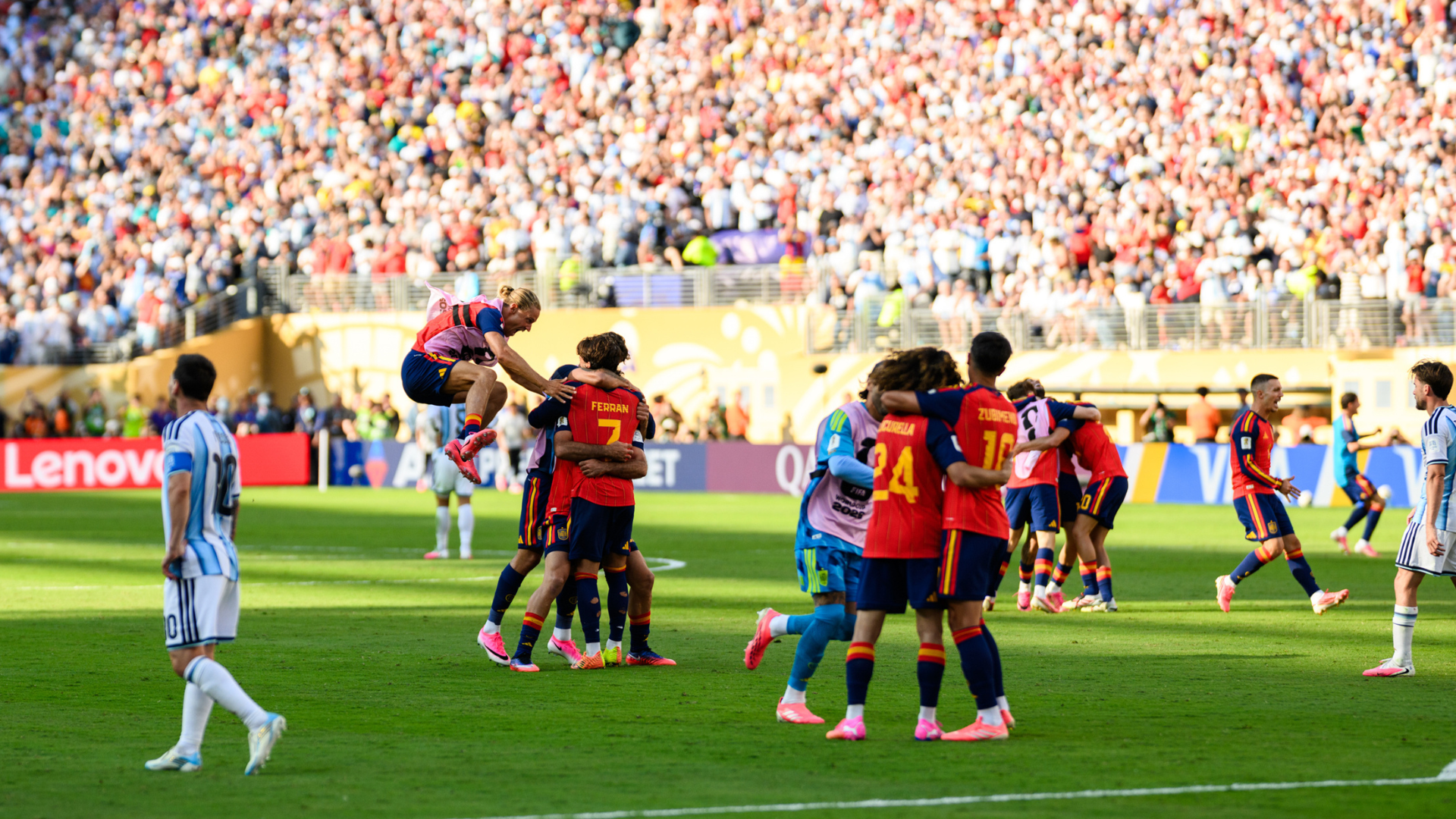
When Argentina had the ball, Spain closed the space around Messi. After 90 minutes, the score was still 0-0. In the 100ᵗʰ minute, Spain’s substitute Ferran Torres jogged in with a clean, dry jersey. He stretched and shook off his legs.
Six minutes later, Porro received the ball and sent a long diagonal across the field. Nico Williams, his ponytailed dreadlocks flying, raced across and nodded it toward the middle of the penalty area to Torres.
The substitute, barely six minutes into the game, smashed the ball into the net44. Spain had nabbed the golden trophy.
Spain’s screeching tires had finally found grip. The team had swerved clear of complacency with pace, directness and unpredictability.
In 2010, Iniesta’s winning goal came at the end of a procession of backheels, dribbles, crosses and feints. 16 years later, Spain needed just three passes to reach the same destination.
The game had moved on, and Spain finally caught up. That’s the trick with any institution built to last. Complacency can leave you stranded while everyone else speeds past. To stay on the expressway, you have to find that sweet spot45 where hunger drives success, and success begets hunger.
As the Catalonian sculptor of tiki-taka Guardiola himself said, “Always, I am starving.”46
Notes
1. David Smith, 2010 World Cup: A Brief History of the Vuvuzela, The Guardian (June 2010)
2. South Africa 2010 Tournament Review, FIFA (August 1, 2026)
3. Netherlands at the FIFA World Cup, Wikipedia
4. Spain at the FIFA World Cup, Wikipedia
5. Rinus Michels, Encyclopaedia Britannica
6. Total Football, FIFA (January 4, 2023)
7. David Winner, Johan Cruyff: Father of Modern Game Who Also Shaped Dutch Culture, The Guardian (March 25, 2016)
8. FC Barcelona Official Website, FC Barcelona
9. Pep Guardiola, Wikipedia
10. Sam Marsden, Barcelona’s Historic 1992 European Cup Opened Door for Dominant Era, ESPN (May 19, 2017)
11. What Is Tiki-Taka? Tifo Football by The Athletic, YouTube (April 9, 2020)
12. Positional Play: Football Tactics Explained, The Coaches’ Voice (November 10, 2021)
13. Lionel Messi, FIFA
14. 2008–20: The Best Years in Our History, FC Barcelona
15. Felipe Villar-Álvarez and José A. Mena, Football Talks with Vicente del Bosque, ScienceDirect (November 14, 2025)
16. Obelix, Asterix
17. Soccer City, Institution of Civil Engineers
18. Andres Iniesta Goal vs Netherlands | ALL THE ANGLES | 2010 FIFA World Cup, FIFA, YouTube (July 11, 2021)
19. Andrés Iniesta Interview, The Athletic (January 11, 2023)
20. UEFA EURO 2012, UEFA
21. David Villa Recovering After Surgery on Broken Leg, Firstpost (December 20, 2011)
22. 2012 Spain Case Study, It’s Just a Sport (May 27, 2026)
23. Conor O’Neill, 74 Passes and One Shot: Breaking Down Inter’s 2010 Mourinho Masterclass vs Barcelona, The Athletic (April 29, 2025)
24. Peter Smith, Jose Mourinho v Pep Guardiola: The Story of the Rivalry, Sky Sports (October 26, 2016)
25. Barcelona vs Chelsea, UEFA Champions League
26. FC Bayern’s legendary 7-0 over FC Barcelona | Highlights of the Champions League Semi Finals 2012/13, FC Bayern Munich, YouTube (April 23, 2020)
27. Robin van Persie Header | FIFA Puskas Award 2014 FINALIST, FIFA, YouTube (November 12, 2014)
28. Croatia 2-1 Spain: Match Report, ESPN (June 21, 2016)
29. Paul Fletcher, Italy 2-0 Spain, BBC Sport (June 27, 2016)
30. Adam Bate, Spain Out of World Cup as Sterile Passing Not Enough to Beat Russia, Sky Sports (July 2, 2018)
31. Pep Guardiola Calls Tiki-Taka Rubbish, Admits That He Loathes All the Passing, Bleacher Report (October 16, 2014)
32. Ali Tweedale, Counter-Pressing (Gegenpressing): Football Tactics Explained, The Coaches’ Voice (March 1, 2022)
33. David Clayton, Pep Guardiola: First Words, Manchester City (July 3, 2016)
34. Guardiola Hails Irreplaceable Agüero as Striker Leaves Manchester City, The Guardian (March 31, 2021)
35. Erling Haaland, Wikipedia
36. Gianluigi Donnarumma, Premier League
37. Sandrine Morel, Luis Enrique, the Architect of PSG’s Transformation, Le Monde (May 30, 2025)
38. Andrew McDougall, Spain Go Out in a Blaze of Optimism for the Future, Marca (July 7, 2021)
39. Spain at the 2022 World Cup: Results, Squad, Scorers, UEFA (December 6, 2022)
40. Sam Leveridge, Who Is Luis de la Fuente? The Man Behind Spain’s Golden Generation, Yahoo Sports (July 20, 2026)
41. Ben Church, Barcelona’s Teenage Star Lamine Yamal Is Touched by the Wand of God, CNN (October 10, 2023)
42. Nicholas Williams Arthuer, Athletic Club
43. Sam Jones, Spain’s New Stars Lamine Yamal and Nico Williams Transform the Game and Attitudes, The Guardian (July 14, 2024)
44. Ferran Torres Goal | Spain 1-0 Argentina | FIFA World Cup 2026™ Final, FIFA, YouTube (July 20, 2026)
45. “Our Philosophy”, Pāri Washington
46. I Am Always Starving: Guardiola Unbowed as Man City Deal with Champions League Fall-Out, Goal (May 7, 2022)