


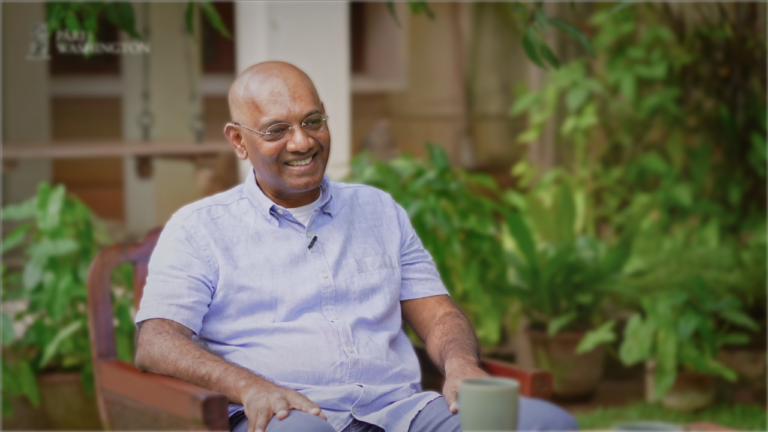
Turn into one of the side streets of Kalakshetra Colony in South Chennai and you will hit a cul-de-sac. Here the honks and growls of traffic grind to a halt, giving way to rustling leaves and a chorus of birds. A three-storied building appears at the bend with a brass name plate catching the light at its entrance. This is the oldest of Pāri Washington’s three homes in Besant Nagar.
As you go past conference halls and jog up a flight of stairs to the top floor, the neighbourhood unfurls: green canopies, low terraces, and light caught in leaves. The colony draws its name from the Kalakshetra Foundation, the nearly century-old academy of classical dance, where the beats of dancing feet echo through the maze-like roots of a giant banyan tree.
Kalakshetra was founded in 1936 by Rukmini Devi Arundale, a theosophist, parliamentarian, and key Bharatanatyam revivalist. The school drew inspiration from poet-philosopher Rabindranath Tagore, who founded Santiniketan as a lush, open-air seat of learning in the Indian state of West Bengal. In Chennai, Kalakshetra’s hundred-acre campus stretches beneath peepul, jamun and tamarind trees, its open classrooms scattered in their shade and the sea breathing beyond the woods.
Here, Rukmini Devi Arundale wove myth into art. The dance dramas still pull packed houses into the conical auditorium, which is built like a Kerala koothambalam, or a traditional temple theatre with a tiled roof and timber beams. During these spellbinding performances, a live orchestra breathes as one: flautists nodding, percussionists slapping the beat, Carnatic vocalists trading riffs with the nattuvanar who breaks into rhythmic syllables like tha, thai, thom. All of this converges on dancers who shimmer under chasing spotlights in vintage silk and imitation heirloom temple jewelry: gold and ruby nose rings, bangles and chokers originally crafted for gods.
On the streets leading to this magnificent arena, you may spot dance students in crisp cotton half-sarees racing past on two-wheelers or hurrying on foot to their classes at Kalakshetra.
Hop into an auto that weaves through the streets and it feels like peering through View-Master or a hand-held 3D viewer with image reels. Each turn is a fresh frame clicking into place: jasmine garland sellers, tender coconut vendors, hawkers splitting the morning with cries of “Keerai!”, their carts literally a shade card of greens with bunches of native spinach in every variation.
Next, you turn into the Besant Nagar bus depot where buses heave, hiss and lurch with conductors hanging from the doorway, blowing a shrill whistle and hollering “right, right!” before each departure toward Perambur, Vadapalani, or Broadway. Across the road, a board announces: Chennai Metropolitan Water Supply. As you enter through the gate, you find an unusually decorated water tank with ornate pillars rising from its base and a nondescript office tucked beneath.
Crane your neck and six lion-like figures with intricate manes, intent eyes and curling tails peer down from above. These are Yalis, mythical guardians sculpted as composites of fierce creatures, standing sentinel on South-Indian temple pillars or towers. Here they keep vigil over a water tank with their mouths flung open to reveal sharp fangs.
If you cut through the bushes flanking the water tank and peer over the wall, you’ll see priests murmuring through rituals. Worshippers stand rooted to the spot with their eyes sealed, hands wrapped around a plate of coconut, banana, holy basil leaves and roses. Other devotees orbit the main idol, palms pressed together, lips chanting.
This is the Varasiddhi Vallabha Vinayagar Temple, home to a boon-conferring form of Ganesha, Hinduism’s elephant-headed god. On some days, ribboned and garlanded new cars are stationed outside, waiting for their owners to crack a coconut as an offering before rubber meets asphalt. Coconuts carry weight here. Come on an auspicious day and their remnants are everywhere: flung on the road, split wide open, their water seeping from broken halves scattered across the entrance.
This temple junction is a riot of activity. Vegetable stalls spill over with beans, banana stem and okras. Tender coconut sellers wield their sickles in swift clean arcs, lopping off the top and pushing in a straw for parched customers. Meanwhile, devotees yell out their list to vendors across stalls heaped with piles of betel leaves and garlands, thick with the smell of ash, sandalwood and camphor.
But a few yards away, the volume drops. You’re greeted instead by a sea of calm, marked by wild and papery tangles of dark pink, white and orange flowers of bougainvillea along the walls of the Olcott School, named after Colonel Henry Steel Olcott of the U.S. Army. In 1865, Olcott was tasked by the Department of War with investigating the assassination of Abraham Lincoln, the 16th President of the United States. Later, Olcott walked away from all of it for Theosophy. We will come to what that means in a bit.
Meanwhile, we’re at Besant Avenue, and it has always kept its own pace. Here, sweaty joggers and speed walkers steal a glance at their smartwatches mid-stride. You’ll see dogs of all shapes, sizes and personalities: from burly Labradors to stumpy Dachshunds and wiry little indies. Some growl sensing a foe, others wag in delight on spotting a friend. Pet parents trudge alongside, some glued to their phones, pausing for their dog’s ritual sniff and inevitable business.
The avenue runs beneath a leafy dome of ancient rain trees, their thick trunks holding tiny leaves that droop at the sign of dusk. Pink powder-puff flowers scatter through the green twice a year. We are just outside the 260-acre campus of the international headquarters of the Theosophical Society.
In 1875, controversial Russian occultist Helena Blavatsky had an idea that every religion in the world was reaching for the same truth, just from different directions. She and Olcott founded the Theosophical Society, and its World headquarters is perhaps an expression of that belief. Past its rickety Besant Avenue gates, weathered colonial buildings sit in the shade of flame-of-the-forest and copper pod trees, their branches erupting in orange and gold blossoms.
Wander further into the mud path and you will find a Hindu shrine, a mosque, a Buddhist temple, a Zoroastrian temple, a Catholic church, and a Sikh shrine, all within steps of one another inside the campus. Together, they signal that no single faith holds the whole truth, and that all of them, side by side, might come closer to it.
As you go deeper into the Theosophical Society, you will be stopped in your tracks by a 450-year-old banyan tree, known locally as the Adyar Aala Maram, under which visionaries like freedom-fighter Annie Besant and philosopher Jiddu Krishnamurti held audiences rapt beneath the shade. Braced by a scaffolding of aerial roots, the canopy spreads across an area nearly the size of a football field.
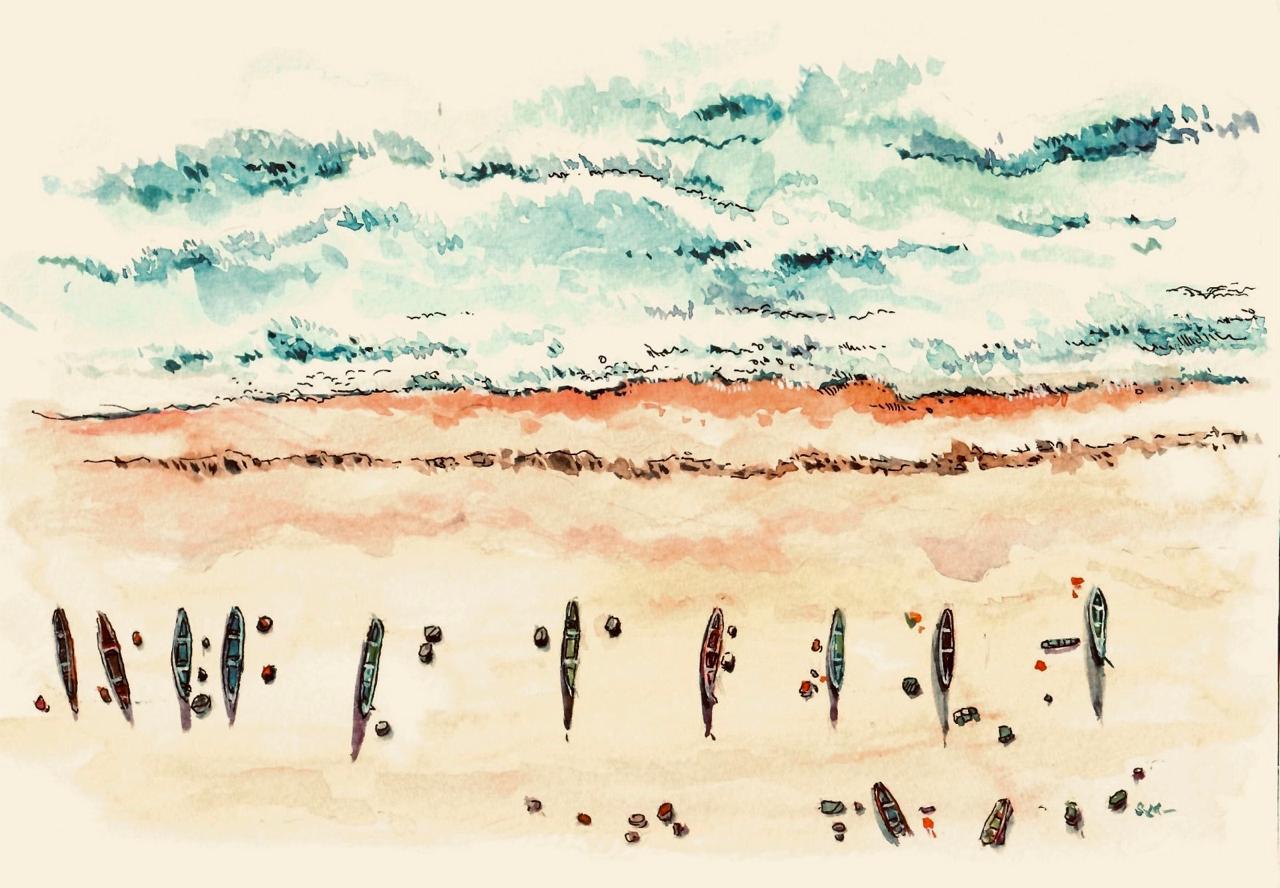
Just beyond this mammoth tree is the mouth of the Adyar river that spills into the Bay of Bengal. The end of the river’s journey signals the start of Bessie, or Besant Nagar beach as it is formally known. You will be hit by the smell of damp sand and briny seaweed, and the constant undertow of whooshing waves.
You finally see the Bay of Bengal stretching endlessly into the east. Set back from the shore, across the road, is a bamboo gate. As you push past the groaning gates, the tree-lined world of feminist, non-conformist dancer Chandralekha opens. After moving from Gujarat to Madras, Chandra, as she was fondly known, learned Bharatanatyam, only to dash away from it. With her big red bindi, long silver hair left open, red tie-dyed sari, thick kohl and silver bangles at her wrists, Chandra was a singular, unforgettable presence in Besant Nagar until her death in 2006.
Kalakshetra performances were a feast for the eyes. Dancers’ costumes were tailored to the last fold and fan, their jewelry precisely matched. Many of Kalakshetra’s dance dramas were built around devotion. Chandra stripped everything back. There were no gods, no narrative, no elaborate costumes in her performances. Using yoga and Kalaripayattu, a south Indian martial art of explosive leaps and high kicks, she replaced devotion with the body’s raw power, measured movement and sexuality. Dancers moved as if entranced, sometimes stretching their legs into a full split, hips pressed flat to the ground. In other postures, their spines arched back until fingers brushed heels. Then, without warning, they snapped upright with fierce Kalari kicks.
Chandra’s dancers performed in a sunken space framed by bare brick walls and a sloping terracotta roof filtering the light. The audience sat close enough to touch the dancers and felt the air move when a kick came.
In 1984, she performed at Kalakshetra to an appreciative Rukmini Devi Arundale. Think about that for a moment. The two women had built entirely different worlds from the same tradition. Yet, they were in the same room, discovering in each other something worth respecting. Their differences were real, but their curiosity was bigger than their convictions.
As you step out of Chandra’s gate, the promenade erupts as a jukebox of sounds: air rifles cracking, merry-go-rounds creaking under the weight of deliriously wild children. A thin ting often cuts through this cacophony. It’s the sonpapdi seller’s bell, which is a perfect Pavlovian trigger for every sweet lover on the beach. These flaky, cobweb-like sweets that you can tease apart like cotton melts in your mouth.
Stand at Bessie long enough and the beach will tell you its stories, one of them being that of Kaj Schmidt. The Danish sailor jumped into these very waters in December 1930 to save a young English girl from drowning. He sacrificed his life to save hers. The then colonial Governor of Madras, as Chennai was once called, built a white archway in his honor at the beach. It still stands, freshly renovated and whitewashed by local restoration efforts.
Soon, the sun turns tangerine and the gopurams or towers of the shore temples dissolve into an orange skyline. The beach, meanwhile, turns into a snack buffet.
Stalls line the promenade selling everything from smoking molaga bajji, or chili fritters, to glossy chocolate-dipped strawberries. But the headlining act is the fish stalls right at the beach. On most days, fresh catch, dripping with batter is dunked in sizzling oil until it grows a sandpapery crust. Ravenous customers crunch into the smoking, crispy skin, and immediately the moist, flaking flesh falls apart, sliding down their throat.
The stalls are run by fisher folk whose ancestors have lived for centuries at the beachside kuppam, or settlement. Before the crack of dawn, they are already pushing their boats in unison into the shallows, jumping aboard, disappearing into a sea that has fed their families for generations.
Many of them have fish stalls on the southern corner of the beach. These are little more than ramshackle planks piled over stones and crates, laden with the day’s catch: vavval, or pomfret, lying like a flat silvery arrowhead; nandu, or blue swimmer crab, placed with its hard shell up and legs folded in; and nethili, or anchovies, piled in a shimmering heap. The air rings with people haggling and the slap of fish on wet wood. Glance up from here and you snatch a view of a blue dome with two flanking spires.
This is a replica of the Basilica of Our Lady of Good Health in Velankanni, a small coastal town 350 kilometers south of Chennai. Step inside this catholic church, built in honor of the Tamil version of Mother Mary, and stained-glass windows cast a rainbow of colors across the floors. Painted ceilings curve overhead. Devotees throng the shrine, sometimes traversing great distances barefoot in penance or out of respect, to seek Mother Velankanni’s blessings and to enjoy Besant Nagar after.
As the evening ends, the church bell continues to clang every hour, startling the bajji eaters mid bite, the balloon shooters mid shot, and the children on the merry-go-round, mid spin. As the sun disappears, a disheveled procession of beach goers trudge towards the Besant Nagar bus stop. Some have their trouser legs rolled up to the knee. Others are swaddled in towels, having been shoved gleefully into the waves by unruly friends.
And that is Besant Nagar, Pāri Washington’s neighborhood, seen from the sandy streets. See it all come alive through our video here.


We use cookies to collect analytics to help improve your experience. Pāri Washington does not collect personally identifiable information.