

Needles of green grass tailed with mud flew from football turfs across the U.S., Canada, and Mexico, marking the kickoff of the 2026 FIFA (Fédération Internationale de Football Association) World Cup.
Hand-scrawled posters, rainbow wigs, and painted faces chanted the names of Kylian Mbappé and Lionel Messi. These weren’t confined to stadiums and television screens. France’s dark blue and Argentina’s striped powder-blue jerseys, both bearing No. 10, rippled through crowds on streets everywhere. The world’s population transformed into Mbappés and Messis, in every conceivable size, from tiny children to broad-shouldered adults.
Yet the World Cup is never only about these two greats. As the group stage unfolded, lesser-known teams and unfamiliar names peppered conversations. During the Democratic Republic of the Congo’s opener against Portugal, one name made some Tamil-speaking viewers squint in disbelief.
Patrolling midfield for the Central African nation, wearing a red, blue, and yellow jersey, was Samuel Moutoussamy. It was a familiar name wrapped in an unexpected spelling.
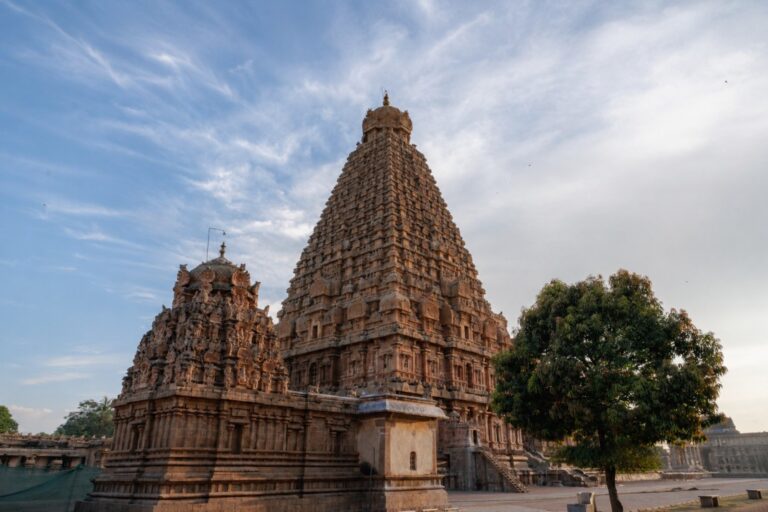
Tamil viewers probably instinctively sounded it out: rounding, puckering, and pressing their lips to pronounce Mou-tou-ssa-my. Once spoken aloud, the puzzle dissolved. Moutoussamy was unmistakably Muthuswamy, a familiar South Indian name meaning “Pearl Lord.” It is one of the many names of the Hindu deity Murugan, whose hilltop temples are among the best-known landmarks of Tamil Nadu.
From Southeast Asia to Mauritius and onward to the Caribbean, Tamil names traveled with migrants under British, French, and Dutch rule. Along the way, new spellings were tailored by colonial officials using English and French spelling conventions. Muthuswamy became Moutoussamy and Narayana became Naraina. The names are breadcrumbs leading to Tamil Nadu, on India’s southeastern coast along the Bay of Bengal.
For more than two centuries, Tamils went back and forth across this sea. Some traveled with capital to invest. Others crossed the sea clutching appointment letters for government jobs. A few set out with minimal belongings knotted into a bundle. They sponged up the atmosphere of the places they drifted into and left traces of their own. Towns and cities bordering the Bay of Bengal became living, breathing intertidal zones, shaped and reshaped by the ebbs and flows between Tamil Nadu and the wider Bay.
Merchants Make a Move
A sea is often viewed as a vast expanse, a divide between people and nations. But the Bay of Bengal flips that script. Historian Sunil Amrith1 describes it as a connecting freeway.
Amrith himself was born in Kenya to parents from Tamil Nadu and raised in Singapore. He sees the Bay of Bengal as a route that stitched the Cholamandalam Coast of eastern India (anglicized by the British as Coromandel Coast) into a single maritime world with Ceylon (now Sri Lanka), Burma (now Myanmar), the Malay Peninsula (present-day Malaysia and southern Thailand), and Sumatra (Indonesia).
Between 1840 and 1940, some 28 million migration movements by Indians were recorded in both directions along this circuit. The Bay of Bengal had become a massive thoroughfare of people, comparable in scale to the great transatlantic movement of millions of Europeans to the Americas in search of land and work.
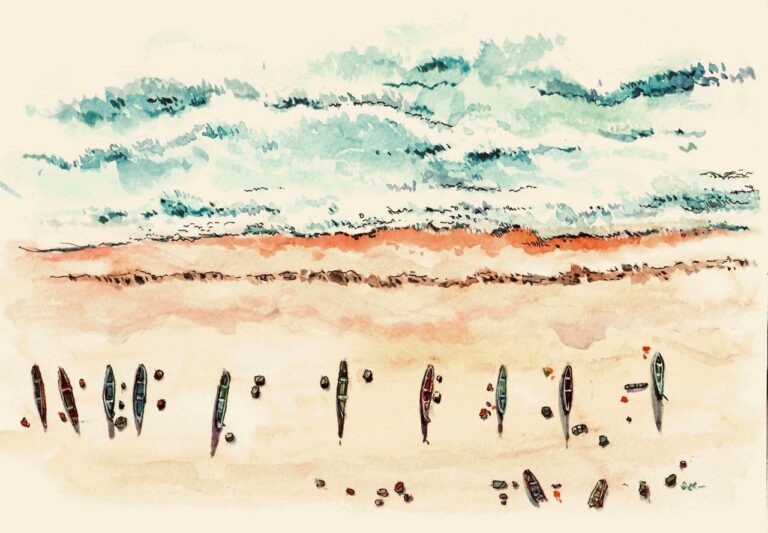
Passengers jumped on boats riding the dependable monsoon winds. If the breeze failed, boats bobbed by their anchors. Merchants, pilgrims, and migrants sauntered back to the jetty and settled wherever they could. The sea would decide when it was time to leave. It demanded a patience today’s travelers, forever checking departure boards and phone screens, rarely possess.
Fortunately, such delays were usually brief in the Bay of Bengal as the monsoons arrived like clockwork. Sailors would set sail from Tamil Nadu’s coasts when favorable winds smoothly propelled their sails across the water towards the east. The waves heaved beneath them as timber creaked and sails snapped overhead.
After weeks or even months of trading in Southeast Asia, they waited for the winds to shift and carry them back home.
When ships docked in the ports of Southeast Asia, it didn’t feel foreign to Tamil travelers. The air was thick with a familiar tropical heat. Coconut palms swayed above crowded waterfronts where slender Arabian dhows, broad-bellied Chinese junks, and European merchant ships jostled for space. In the bazaars, amid the cries of traders selling pepper, cotton, rice, tin, and opium, Tamil tangoed with Malay, Cantonese, Arabic, and English.
Among the most influential businesspeople to migrate were the Nattukottai Chettiars2, financiers from the arid Chettinad region of Tamil Nadu. Nattukottai translates as “fortified settlement” in Tamil. It was a label for the grand ancestral mansions of Chettinad, decorated with pillared courtyards, Burmese teak doors, and Belgian stained glass. The wealth of the Chettiars came from commercial banking networks across Asia.
There’s an ode to them in Singapore’s financial district. Perched on the steps overlooking the Singapore River is a bronze sculpture3 titled From Chettiars to Financiers. The tableau includes a bronze figure of a Nattukottai Chettiar dressed in a simple dhoti, sitting cross-legged with an accounting ledger resting on a low-set desk or pettiyadi. Beside him, a Chinese trader calculates on an abacus and across, a modern banker in a business suit raises a hand in greeting.
At a time modern banking scarcely existed across much of colonial Asia, the Chettiars offered financial services through the continent. Operating via small branches in Ceylon, Malaya, Singapore, Vietnam, and Myanmar, they built a banking network founded on trust, community ties, and rigorous bookkeeping.
But the Chettiars were not the only Tamil entrepreneurs to cross the sea.
Walk into almost any Malaysian town after sunset and the mamak4 stall is impossible to miss. Plastic tables spill onto sidewalks and waiters weave through chatting crowds balancing frothy glasses of tea. At the counters, cooks briskly stretch discs of dough until they are almost transparent before pleating, rolling and frying them into flaky, golden roti canai.
These cafés are neighborhood communes, where taxi drivers, students, and office workers gather over steaming plates of food every day. But their roots lie across the Bay of Bengal, with Tamil Muslim migrants from coastal towns such as Nagore, Kayalpattinam, and Kilakarai.
The name mamak5 itself comes from the Tamil word māma, meaning “uncle”—a warm, respectful way of addressing the Tamil Muslim vendors from the Maraikkayar community of coastal Tamil Nadu. Over time, the nickname came to be both the community and the eateries themselves.
The word Maraikkayar can be traced to the Tamil marakkalam, which means “boat” or the Arabic word for it, markab. There is evidence that some Maraikkayar families6 supplied horses, the battle tanks of their time, to South Indian courts in the pre-medieval and medieval era, including to the Pandian kings, whose dynasty was one of the longest ruling in the world.
Marco Polo, the Venetian traveler who visited South India around 1292, was captivated by the horse bazaar at Kayal7, a bustling Pandian port on the waters between southern India and Sri Lanka. Here ships arrived from Arabia laden with horses. The clatter of hooves mingled with the calls of Pandian cavalrymen waiting to inspect them.
The Rowther8, another Tamil Muslim community, were also involved in the horse trade. Their name comes from the Tamil word for “horseman,” and they were probably descendants of Turkish traders. Horses imported from Arabia were perhaps the mainstay of Maraikkayar and Rowther trade into Tamil country.
Much of the early Muslim influence9 on Tamil Nadu’s coasts came from Arab horse merchants from places such as Yemen and parts of West Asia. Eventually they pitched their tents in South India, marrying locally. Their descendants, the Maraikkayars and the Rowthers, developed a distinct Tamil Muslim identity. Then the travel bug bit them again and they set sail once more, this time to Southeast Asia. For many, crossing the Bay became as ordinary as taking the road to the next town.
They traded textiles, spices, timber, and precious goods between ports on the Coromandel Coast—spanning much of present-day Tamil Nadu and southern Andhra Pradesh—and those in Sri Lanka, the Malay Peninsula, and the Indonesian archipelago. Several settled in Penang, Malacca, and Singapore.
Along these waterfronts, bales of cotton10, sacks of pepper, and Burmese rice disappeared into Tamil-owned warehouses, while the haunting call of the muezzin drifted from mosques over the cries of dockworkers along the waterfront.
Every trading house overseas became the nucleus of a growing community. Singapore became the richest expression of that world.
Clerks Jump Aboard
The history of Singapore’s Tamil community is often told through the story of Naraina Pillai11.
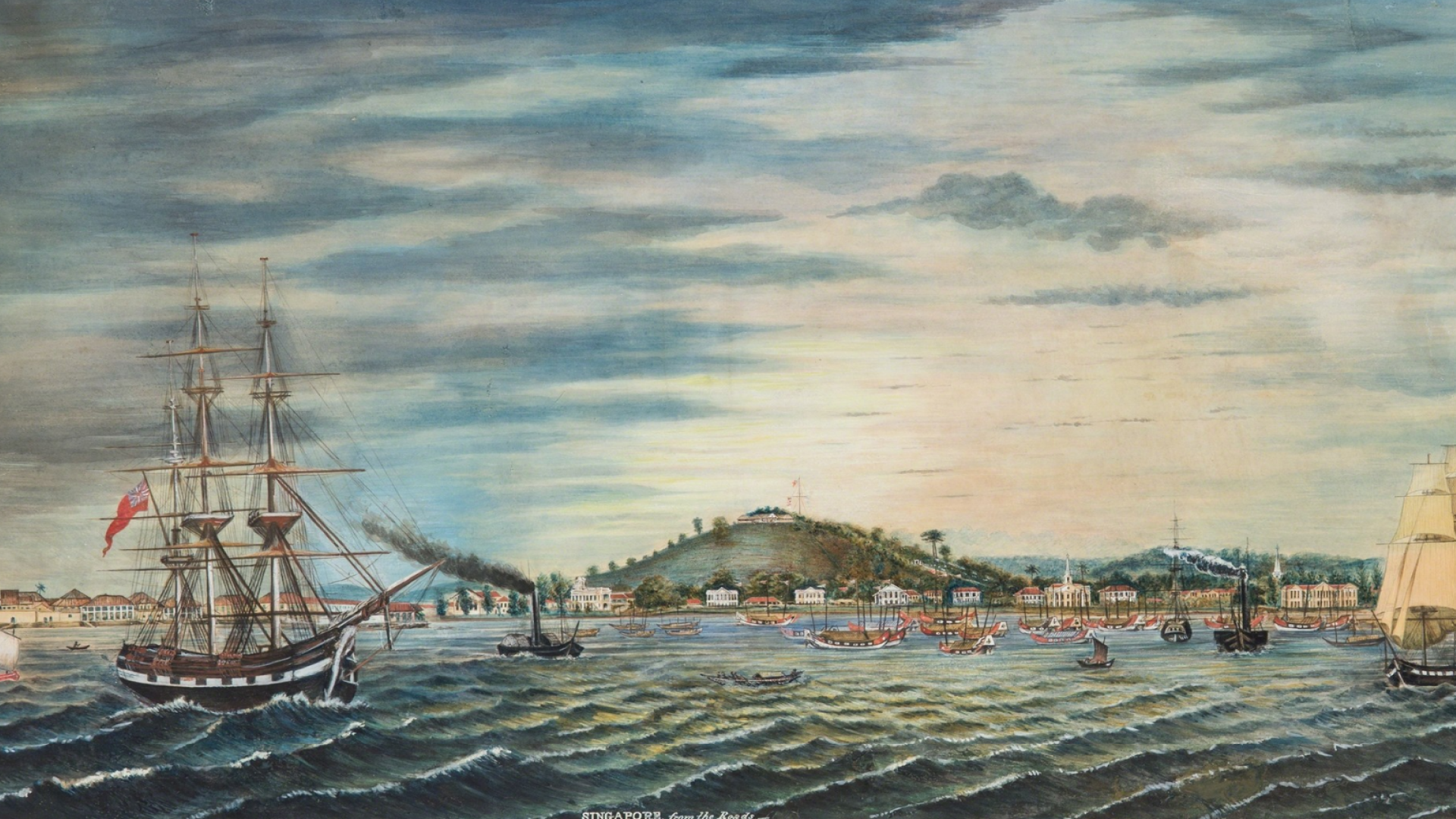
On January 28, 1819, the East India Company ship Indiana dropped anchor off Singapore12. The name meant “Lion City” and is said to have Sanskrit roots, but the idea was familiar in the Tamil world too. The Chola13 rulers of southern India had repeatedly sent their forces to this region, possibly as a show of strength for the trading posts they had established here. Singapooru14 was a familiar Chola-era Tamil place name.
Aboard the Indiana was Naraina Pillai, a young government clerk from Penang. Also on the ship, but traveling independently and in first class, was Sir Stamford Raffles, the British official who laid the foundations of modern Singapore. They were headed towards a place that had been welcoming merchants for centuries.
Early 19th-century Singapore was a Malay settlement at the mouth of the Singapore River, surrounded by mangroves and tropical vegetation. The skyline that defines the city today was nowhere in sight.
Raffles stepped ashore to negotiate the setting up of a trading port with the island’s Malay chief over bowls of rambutans15—bright red fruit covered in soft, hair-like spines that peeled open to reveal sweet white flesh like a lychee. For Pillai, the trading port held promise. He found work as a treasury clerk, or shroff, whose job was to examine coins and ensure they were genuine.
As the 19th century unfolded, the British Empire was no longer just conquering territory. It was learning how to govern it. Across India, Burma, Ceylon, Malaya and East Africa, colonial administrations needed clerks16, accountants, surveyors, teachers, customs officials and railway administrators to keep the machinery running.
The colonial state was built on making society easier to classify, record and control. Britain did not have enough Europeans to fill all these posts, so it increasingly relied on English-educated Indians. Among those in demand were Tamils from the Madras Presidency and Jaffna17 in northern Ceylon, an old Tamil-speaking community with millennial ties to South India.
Missionary and government schools spread English-language instruction across southern India and northern Ceylon, opening a path into the growing colonial bureaucracy.
Some, including Naraina Pillai, may have come from families of kanakkupillais18—village accountants and scribes who had long served kings, temples, financiers, and landowners, keeping track of land, taxes and transactions.
But Pillai’s job as a treasury clerk was short-lived. When a more senior official arrived from Malacca (present-day Malaysia), Pillai was dismissed. But he stayed on, hoping to build his life in Singapore.
The timing could hardly have been better. Singapore was expanding at breakneck speed. Every shimmying ship brought in hungry traders plotting cavernous warehouses that needed heaps of bricks.
So Pillai set up Singapore’s first brick kiln on the diamond-shaped island’s southwest coast. Then he wrote to friends in Penang, asking them to send bricklayers, carpenters, and skilled craftsmen from India’s Coromandel Coast.
They answered the call. Across the Bay came laborers carrying chisels, hammers, and traditional skills. Brick by brick and beam by beam they built homes, warehouses, and places of worship to shape modern Singapore.
Merchant-owned vessels increasingly ferried workers from British-ruled South India to Penang, Singapore, and Malaya. Shipping agents recruited workers through networks of relatives and village headmen and connected them with employers across the sea. The story of the Tamil diaspora had entered a new chapter.
Laborers Set Sail
By the middle of the 19th century, the Bay had become a route for mass labor migrations.
Its genesis19 lay in the lush Caribbean island of Jamaica, south of Cuba, where sugarcane shoots carpeted plains. Following years of protests here, Britain passed the Slavery Abolition Act in 1833.
Now, it would have looked contradictory for Britain to celebrate the end of slavery while allowing it to continue in India. That led to the Indian Slavery Act of 1843.
The law said no human being could be bought, sold, or owned as property. Yet the empire’s appetite for labor only grew, as plantations expanded and demand soared for workers to grow tea, coffee, sugar, and rubber. Malaya’s rubber20, in fact, fed the American automobile industry.
While the Malays continued in village agriculture and fishing, Chinese migrants in these regions gravitated toward tin mining and urban commerce. Unable to recruit sufficient local labor, plantation owners looked to the Cholamandalam or Coromandel Coast.
Around the 1830s21, hundreds of thousands of poor Tamils crossed the Bay of Bengal and the wider Indian Ocean to work in Ceylon, Malaya, Burma, Mauritius, Fiji, South Africa, and the Caribbean.
They came from villages across what are today Thanjavur, Tiruchirappalli, Madurai, Nagapattinam, Pondicherry, Tirunelveli, and beyond. Many belonged to Dalit and farming communities, trapped by erratic rains, debt, and caste.
Then came the Madras Famine22 of 1876–78. Grain became scarce and prices skyrocketed. The crisis deepened as exports of food continued.
Decades later, economist Amartya Sen23 would show, through his study of the Bengal famine of 1943, that such tragedies could be man-made. People can starve even when food is available when rulers are not democratically elected and not answerable to the ruled.
For those already living on the margins, the famine was the final nail in the coffin. Debts deepened and leaving home was the only option to survive.
Initially, Tamil workers signed indenture contracts chaining them to several years of work in exchange for a ticket across the sea, wages, and housing. On paper, the system appeared to differ from slavery because workers entered into contracts voluntarily. But recruiters frequently exaggerated wages or concealed working conditions.
In much of Southeast Asia, these laborers were recruited and managed through a system known as kangani24. The word was derived from the Tamil word kankani, meaning overseer, and referred to trusted laborers already employed on plantations. Estate owners sent these men back to their home villages to recruit relatives and neighbors. Such agents sponsored travel expenses, organized voyages, and controlled the workers after their arrival.
Unlike the wealthy merchants who commanded their own vessels, plantation workers traveled in crowded ships crossing the Bay of Bengal. Colonial officials increasingly expressed alarm at the state of these vessels. Reports described passengers packed into dangerously overcrowded boats with inadequate provisions and poor sanitation. Many got sick and several died25 even before the ships reached Penang or Singapore.
At the emigration26 depot in Nagapattinam, a colonial magistrate questioned each laborer, requiring him to declare that he was leaving willingly and understood the work that awaited him. After six or seven days at sea, the worker landed in Malaya and passed through quarantine. From there, he was transported inland to landscapes utterly different from the bustling ports where he had first disembarked. There, he lived under the watch of overseers, police, magistrates, and medical inspectors.
In the cool highlands of Ceylon, Tamil workers cleared dense forests to plant tea bushes that would eventually supply to breakfast tables across Britain. In Malaya, laborers hacked through tropical jungles to establish rubber plantations that fed the booming global demand for automobile tires. Others laid railroad tracks, built roads, dredged harbors, or worked on municipal sanitation projects in rapidly expanding colonial cities such as Singapore, Kuala Lumpur, and Rangoon.
Estate housing was cramped27 and poorly ventilated. Diseases28 claimed thousands of lives. Access to medical care was limited, while wages barely covered daily necessities. For many families, debt remained a burden even after crossing the sea.
Gradually, what began as a temporary migration became permanent settlements. Employers started recruiting women, recognizing that families were less likely to leave estates after completing their contracts. Children were born in plantation hospitals rather than villages in Tamil Nadu. A second generation grew up speaking Tamil at home, Malay or, occasionally, English in school, and regarding Malaya or Ceylon—not the Coromandel Coast—as home.
Converging Worlds
Ultimately, the ports cradling the Bay of Bengal were a living kaleidoscope, reshuffling people, faiths, and cultures.
For many Tamil Muslim laborers arriving in 19th-century Singapore or Penang, there was an unexpected sight waiting amid the bustle of the port. Rising above Singapore’s and Penang’s bustling streets were the familiar white minarets. These were shrines dedicated to Shahul Hamid, the 16th-century Muslim mystic and spiritual teacher from Nagore, a small town on Tamil Nadu’s Coromandel Coast.
Like the magnificent dargah back in Nagore29, with white walls, soaring minarets, and a golden dome, these shrines recreated a familiar skyline in the port cities of Southeast Asia.
Chettiar merchants, too, financed temples dedicated to Shiva, the Hindu god of transformation and renewal, and his son Murugan in Penang, Kuala Lumpur, Rangoon, Hanoi, Saigon, and Singapore.
In 1823, Naraina Pillai petitioned the colonial authorities in Singapore for land to build a temple30. Four years later, a modest wooden shrine rose dedicated to Mariamman, the fierce village goddess whom generations of South Indians worship to this day for protection and rain. It became a hotspot of Tamil culture in the heart of Singapore, where vendors sold jasmine garlands and coconuts offerings. Incense scented the air and temple bells rang mornings and evenings. Today it is recognized as Singapore’s oldest Hindu temple and as a national monument.
During the Tamil month of Ādi, which is dedicated to Mariamman, families flocked to offer prayers and seek her blessings. Thaipusam31, dedicated to Murugan, became one of the most spectacular expressions of Tamil identity in Singapore and Malaysia. Devotees walked in colorful processions carrying kavadi—ornate wooden or metal structures, often adorned with peacock feathers. Neighbors from every community lined the streets to watch.
Nearly two centuries after the first indentured workers arrived, Tamil festivals remain part of even Mauritius’s cultural calendar.
For a few days each year, distant colonial ports felt unmistakably Tamil. The soaring notes of the nādaswaram pipe pierced through the streets, along with the sharp beat of the tavil drum. The fragrance of jasmine and holy ash lingered in the air as families gathered to pray.
Today, people of Tamil origin make up one of the largest Indian communities in both Malaysia and Singapore. In fact, Tamil is one of Singapore’s four official languages, alongside English, Malay, and Mandarin. In Malaysia, there are Tamil-medium primary schools and in Mauritius, it is taught as an ancestral language in schools.
Food too surfed the waves. Many dishes now regarded as distinctly Singaporean or Malaysian originated from these early Tamil migrations. Delicate nests of steamed rice noodles, known in Tamil Nadu as idiyappam, became putu mayam32 in the Malay Peninsula, served with sweet coconut and palm sugar. Layer upon layer of buttery parotta flatbread unfolded into the crisp, flaky roti canai that is now as Malaysian as it is Tamil. Meanwhile, the practice of repeatedly pouring tea between two vessels to cool and froth it evolved into teh tarik, literally “pulled tea.”
In Singapore, fish head curry emerged when Tamil cooks adapted their traditional tamarind and curry leaf-based fish curries to Chinese diners’ preference for the fish head. The cultural swap flowed both ways—Burmese black rice, or karuppu kavuni arisi33, and fermented prawns and fish34 found their way into Chettinad kitchens.
All of this was driven by trade and opportunity. But these exchanges came crashing down in the 1930s, when the Great Depression sent economies around the world into a tailspin.
In Burma, rice prices collapsed, leaving farmers struggling to repay loans. In Malaya, the slump in rubber and tin led to mass unemployment. Despite these hardships, some Tamil families adopted35 Chinese children—a reminder that love transcended ethnicity.
As immigration controls36 spiked in places like Malaya, thousands returned to India from Southeast Asia. The tide had begun to turn.
Tamil Roots in Congo
As European empires expanded into distant lands with faster sailing ships and better routes, Tamil migrants found themselves carried farther from home, across not only the Bay of Bengal but also the Indian Ocean.
Some sailed west from Madras, rounded the storm-lashed Cape of Good Hope at Africa’s southern tip, crossed the Atlantic, and reached the French Caribbean islands of Guadeloupe and Martinique. The voyage lasted months.
Flying fish skimmed the waves and seabirds cruised overhead. The endless sea slowly gave way to lush volcanic islands fringed by turquoise waters, where sugarcane stretched to the horizon instead of the rice fields they had left behind. They arrived as indentured laborers. Many stayed, pitching tents an ocean away from home.
One of those journeys eventually shaped the family of Samuel Moutoussamy37.
His father’s ancestors were among the Tamils who settled in Guadeloupe, a string of volcanic islands under French rule in the Caribbean Sea. His mother was born in the Democratic Republic of the Congo before migrating to France, where Moutoussamy was born and raised.
France itself has been reshaped by successive waves of migration from Africa, the Caribbean, and beyond—a diversity that has helped make it one of the world’s great footballing nations. Competition for team spots has often been so fierce that players with roots in several countries have chosen to represent their family’s ancestral homeland instead.
Moutoussamy’s decision to wear the colors of the Democratic Republic of the Congo reflects that larger story as much as his own. Clearly, migration has created identities no map or borders could have predicted.
More than two centuries ago, the first ships blared their horns and rolled through the monsoon swells of the Bay of Bengal and into the wider Indian Ocean, carrying migrants far from home. Traces of that voyage live on today in an unlikely place: Moutoussamy’s No. 8 jersey for the Democratic Republic of the Congo.
Notes
1. Sunil Amrith, Tamil Diasporas Across the Bay of Bengal, The American Historical Review, (2009)
2. Anupama Chandrasekaran, What Financial Solidity Means to Us, Pari Washington Company Advisors Private Limited, (August 2026)
3. From Chettiars to Financiers, National Heritage Board, Singapore
4. Mamak Stalls, GOYA, (August 11, 2026)
5. Mamak People, Wikipedia, (accessed September 16, 2026)
6. Susan Bayly, Saints, Goddesses and Kings, Cambridge South Asian Studies, (1989)
7. Anas Babu T, Horse Trade at Kayal, Academia, (2015)
8. Rowther, Wikipedia, (accessed September 16, 2026)
9. Torsten Tschacher, Tamil Nadu’s Muslim Maritime Legacy, KHAKI Lab Mumbai, YouTube (June 23, 2026)
10. Sunil Amrith, Crossing the Bay of Bengal, Harvard University Press, (2013)
11. Naraina Pillai, National Heritage Board, Singapore
12. Aparjeet Nakai, The Origin of Singapore’s Name, Anecdotes of the Ages, (September 28, 2023)
13. Sukhbir Cheema, Singapore Possibly Had Connections With Indian Chola Dynasty, Mashable SE Asia, (December 23, 2019)
14. S. R. Balasubrahmanyam, Middle Chola Temples, Thomson Press (India) Ltd., (1975)
15. Bonny Tan, Stamford Raffles’ landing in Singapore, National Library Board Singapore, (January 2019)
16. Pierre-Yves Trouillet, A Global Hindu Tamil Diaspora?, HAL Open Science
17. Kristina Hodelin, A Colonial Model Minority?, Indian Journal of Asian Affairs (June-December 2021)
18. Significance of Kanakkuppillai, Wisdom Library
19. Gordon Robert Haigh, Dissenting Missionaries, Sheffield Hallam University Research Archive, (2020)
20. Sunil Amrith, Crossing the Bay of Bengal, Harvard University Press, (2013)
21. Christophe Z. Guilmoto, The Tamil Migration Cycle, Economic and Political Weekly, (January 1993)
22. The Making of Madras: The Great Famine of 1876–78, Sarmaya, (October 25, 2021)
23. Amartya Sen, Poverty and Famines: An Essay on Entitlement and Deprivation, Oxford University Press, (January, 1983)
24. Kangani System, Wikipedia, (accessed September 16, 2026)
25. Sunil Amrith, Tamil Diasporas Across the Bay of Bengal, The American Historical Review, (2009)
26. Sunil Amrith, Governing Tamil Migration to Malaya, Past & Present, (August 2010)
27. Sunil Amrith, Tamil Diasporas Across the Bay of Bengal, The American Historical Review, (2009)
28. Suresh Narayanan, South Indian Labour in Malayan Rubber Estates, Economic History Malaysia
29. Nagore Dargah, Wikipedia, (accessed September 16, 2026)
30. Sri Mariamman Temple, Singapore, Wikipedia, (accessed September 16, 2026)
31. Festivals in Singapore: Thaipusam, National Heritage Board Singapore
32. Idiyappam, TasteAtlas
33. Deepa Reddy, Karuppu Kavuni, Shālikūta, (July 27, 2024)
34. Anjuli Shukla, Chettinad Heritage, Robb Report India, (August 25, 2026)
35. Sunil Amrith, Tamil Diasporas Across the Bay of Bengal, The American Historical Review, (2009)
36. Sunil Amrith, Tamil Diasporas Across the Bay of Bengal, The American Historical Review, (2009)
37. Samuel Moutoussamy, Wikipedia, (accessed September 16, 2026)